


Table of Contents
- Introduction
- Digital Tools Enhancing Communication
- Prefabrication and Modular Construction
- Building Information Modeling (BIM)
- Sustainable Practices in Construction
- Integrated Project Delivery (IPD)
- Leveraging Drones and AI
- Cloud-Based Collaboration Platforms
- Conclusion
Efficiency and collaboration are critical to success in commercial construction. As the industry continues to evolve, adopting new strategies and digital tools has become essential for keeping projects on schedule and under budget. From real-time communication platforms to innovative building methods, companies are seeking every possible advantage to improve outcomes and minimize risks. For those embarking on large-scale projects, selecting an experienced design build contractor in Georgia who is well-versed in modern construction processes can set the stage for a streamlined, coordinated effort.
Traditionally, miscommunication and delays caused by unforeseen issues could derail timelines and inflate costs. With the construction landscape growing more complex, companies that leverage technology and integrated collaboration stand out for their ability to move projects forward efficiently. Thoughtful planning and implementation of digital solutions ensure that project information flows freely between team members and stakeholders, reducing the risk of costly errors and delays.
Modern commercial construction must balance ambitious architectural concepts with lean project management. Balancing these objectives means evaluating every opportunity to boost efficiency and maintain a cooperative spirit among architects, engineers, builders, and owners. Embracing the latest best practices, such as integrated project delivery and cloud-based management, is vital for consistency and sustained success.
Another key consideration is environmental responsibility. Sustainable building processes and designs are increasingly in demand, providing lasting operational savings and demonstrating commitment to future-focused development. Beyond regulatory compliance, green initiatives are reshaping how industry leaders approach construction.
Digital Tools Enhancing Communication
Project communication has transformed thanks to digital tools. Platforms such as Procore, PlanGrid, and Autodesk Construction Cloud give teams immediate access to project documents, drawings, and field data. Mobile integration means updates can be reviewed and addressed on-site and in real time, quickly resolving issues before they become larger problems. The integration of project management software with Building Information Modeling (BIM) creates a unified environment where architects, engineers, and contractors can coordinate efficiently, maintaining a single source of project truth.
Prefabrication and Modular Construction
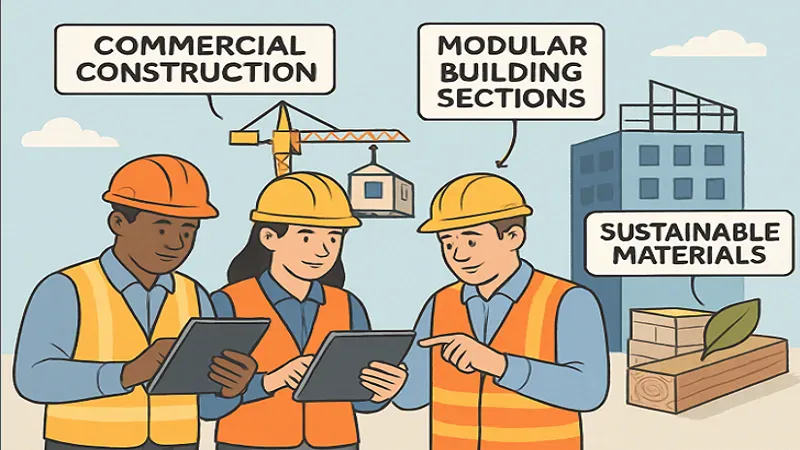
Prefabricated and modular construction delivers efficiency, safety, and cost benefits. Manufacturing building components off-site in controlled environments reduces waste and allows for timely assembly, regardless of weather conditions. These methods help streamline schedules and enhance quality control, enabling faster project delivery and a safer site by reducing the need for on-site labor. Modular construction also offers design flexibility, especially valuable in urban and high-density areas. The method’s scalability is a crucial advantage as cities expand and projects grow in complexity.
Building Information Modeling (BIM)
BIM has evolved from 3D modeling to an operational necessity in commercial construction. It facilitates open collaboration, detailed visualization, and accurate clash detection before ground is broken. BIM is a shared resource that allows stakeholders to simulate design choices, pinpoint constructability issues, and forecast resource needs, leading to a more coordinated process and reduced rework. The National Institute of Building Sciences has highlighted BIM’s role in reducing project risk and improving construction outcomes across the board.
Sustainable Practices in Construction
With stricter energy standards and growing environmental concerns, sustainable construction is now a central objective for commercial projects. By using renewable materials, such as cross-laminated timber and recycled steel, and implementing energy-saving measures, such as advanced lighting systems and HVAC optimization, firms are reducing operational costs and carbon footprints. Smart windows and solar-ready rooftops are now common features in new commercial buildings, combining function with sustainable innovation.
Integrated Project Delivery (IPD)
Integrated Project Delivery brings every stakeholder together early in the process, breaking down potential silos and fostering true collaboration. Under IPD, contracts are structured for shared responsibility and risk, encouraging transparency and proactive problem-solving from day one. This approach results in less rework, faster decision-making, and higher-quality deliverables, as everyone is aligned on goals and incentives. IPD is particularly effective for high-stakes commercial projects, where delays and cost overruns can have outsize impacts.
Leveraging Drones and AI
Drones are now common sights on construction sites, providing rapid, detailed aerial surveys and progress tracking. These devices can identify safety hazards, monitor materials inventory, and evaluate project performance from above. Meanwhile, artificial intelligence analyzes the vast volumes of data produced, detecting trends, flagging risks, and helping managers optimize resource allocation. Predictive analytics powered by AI can foresee schedule slips or cost overruns, allowing teams to address challenges long before they escalate. These technologies create a safer, more informed worksite and help deliver projects predictably and efficiently.
Cloud-Based Collaboration Platforms
Cloud-based platforms are imperative for agile project management. By centralizing documents, updates, schedules, and even inspection records, these solutions enable all team members to work from the latest information, whether on-site or remote. Real-time issue tracking and document management drive accountability and transparency, ensuring teams act quickly on new information and communicate openly. Enhanced collaboration helps resolve conflicts, streamline approvals, and maintain pace throughout the project lifecycle.
Conclusion
Achieving project success in commercial construction depends on integrating cutting-edge tools, collaborative delivery models, and responsible building practices. Leveraging digital innovations, modular methods, and sustainable processes empowers teams to overcome traditional challenges. The result is a more unified, agile, and responsible approach to commercial construction, positioning firms to deliver high-quality results that satisfy both clients and the greater community.



ivermectin dosierung
ivermectin dosierung