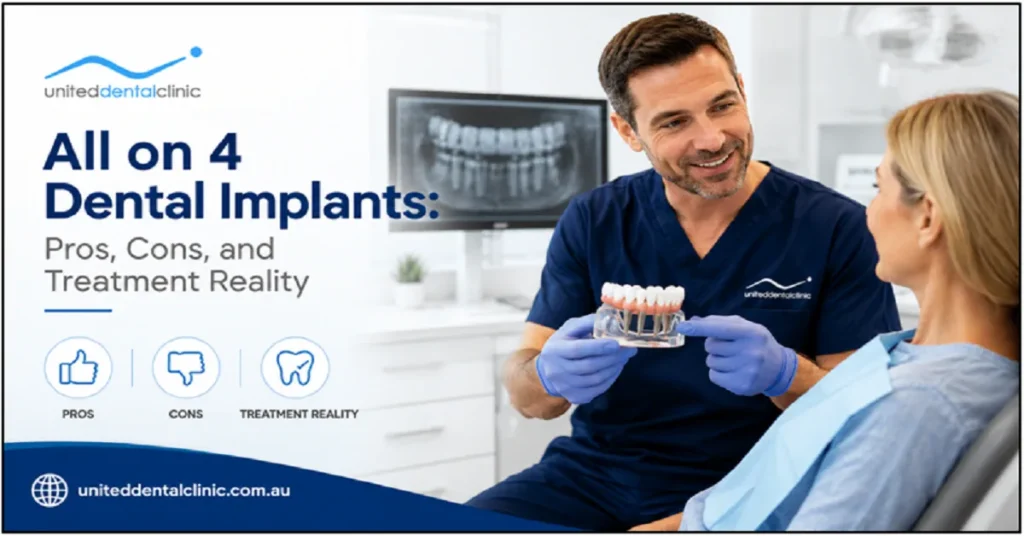

Losing teeth changes things quietly at first. You stop ordering certain foods at restaurants. You angle yourself differently in photos. You laugh with your hand in front of your mouth without really noticing you have started doing it.
A family dentist in Narrabeen hears this from patients regularly. All-on-4 exists specifically for this situation, and this guide explains what the treatment actually involves before you sit down for a consultation.
What Is All-on-4 and How Does It Actually Work?
All-on-4 was developed by Dr Paulo Malo in 1998 and has since been performed on hundreds of thousands of patients worldwide. The procedure places four titanium implants in the jawbone to support a full arch of fixed prosthetic teeth. Two implants sit vertically at the front of the jaw. Two sit at the back at a 45-degree angle, which is the key clinical innovation.
That angled placement uses the denser bone near the front of the jaw. It is what allows the treatment to work without bone grafting in most cases, which was a major barrier with earlier full-arch implant methods. The result is a fixed bridge that functions like natural teeth, secured by four implants rather than the ten or more that traditional full-arch methods required.
The treatment follows five stages:
| Stage | What Happens |
| Consultation | Full dental examination, CBCT scan, and treatment planning |
| Surgery | Four implants were placed under general anaesthetic or IV sedation |
| Temporary teeth | Fixed temporary bridge fitted within 1 to 3 days |
| Healing | Osseointegration — implants fuse with the jawbone over 3 to 6 months |
| Final prosthesis | Permanent custom bridge attached once healing is confirmed |
The all-on-4 dental implants procedure is designed to give patients functional, fixed teeth within days of surgery. That timeline is what sets it apart from traditional implant methods, where patients often wait months before receiving their final teeth.
The Real Pros of All-on-4 Treatment
Fixed teeth that stay in place
The prosthetic bridge is screwed onto the implants. It does not slip during eating, does not require adhesive, and does not need to be removed at night. Patients who have lived with dentures describe this as the single most significant quality of life change. Eating hard foods, speaking without hesitation, and smiling in photos — things that removable dentures make difficult — all return.
No bone grafting in most cases
Traditional full-mouth dental implants, which require up to 10 implants, almost always require bone grafting to provide enough bone for implant placement. All-on-4’s angled placement sidesteps this in the majority of patients, which means less surgery, shorter treatment time, and lower overall cost.
Preserves the jawbone
When teeth are lost, the jawbone beneath them begins to resorb because there is no root stimulating it. Implants act like natural roots, applying pressure to the bone during chewing and preventing that deterioration. Patients who choose dentures continue to lose bone over time. Patients with implants do not.
Faster timeline than any alternative
Temporary teeth are fitted within one to three days of surgery. The final bridge is placed three to six months after osseointegration is complete. Traditional implant methods required waiting up to twelve months before receiving final teeth, with patients in removable dentures throughout that entire period.
High long-term success rate
When planned and placed by an experienced clinician, All-on-4 has a success rate above 98%. With proper care, the implants can last a lifetime. The bridge will eventually need replacement, but the implants themselves are designed to be permanent.
Cons of All-On-4 Treatment
It is a surgical procedure
There will be some swelling, bruising, and discomfort in the first week after surgery. This is expected. Most patients describe it as manageable and return to work the day after the procedure. The discomfort resolves within one to two weeks.
A soft food diet for three months
While osseointegration occurs, patients eat soft foods to avoid placing excessive force on the healing implants. This is temporary. Most patients adjust to it more quickly than they expect, and the final result is worth the short-term change.
The bridge needs maintenance over time
The implants are permanent, but the prosthetic bridge has a lifespan. Acrylic bridges typically last five to seven years before renewal. Zirconia bridges last longer. Regular check-ups and proper cleaning with interdental brushes and a water flosser extend bridge life significantly.
Medicare does not cover the procedure in Australia
Private health cover may contribute to specific components depending on your fund and level of cover. Many clinics, including those offering All-On-4 Treatment in Narrabeen and across the Northern Beaches, offer payment plan options to manage the cost over time.
What Does Recovery Actually Look Like?
The recovery timeline is one of the most common questions patients have before committing to treatment. Here is a realistic, week-by-week picture based on verified clinical data:
| Timeline | What to Expect |
| Days 1 to 3 | Swelling and bruising at peak — rest is recommended |
| Days 4 to 10 | Swelling reduces significantly, and most patients return to work |
| Weeks 2 to 4 | Soft food diet continues, temporary teeth start to feel natural |
| Months 1 to 3 | Follow-up appointments at 4 weeks and 3 months — osseointegration progressing |
| Months 3 to 6 | Final bridge planned and fitted once integration is confirmed |
The procedure is performed under general anaesthetic or IV sedation, so patients feel nothing during surgery. Most patients say the recovery is more manageable than they anticipated. The biggest adjustment in the first few weeks is the diet, not the pain.
All-on-4 vs Traditional Dentures
The difference between removable dentures and full mouth dental implants through All-on-4 comes down to one thing: fixed versus removable.
| Factor | Traditional Dentures | All-on-4 |
| Fixed in place | No — removable daily | Yes — permanently fixed |
| Diet restrictions | Significant — avoid hard foods | Minimal after healing |
| Adhesive required | Yes | No |
| Speech impact | Can affect clarity | Functions like natural teeth |
| Bone preservation | No — bone loss continues | Yes — implants stimulate bone |
| Lifespan | Replacement every 5 to 8 years | Implants designed to last a lifetime |
| Ongoing maintenance | Relining, replacement, and adhesive costs | Regular check-ups and cleaning |
| Upfront cost | Lower | Higher |
| Long-term cost | Accumulates significantly over time | More predictable over the long term |
What to Ask at Your Consultation
Walking into a consultation already knowing what to ask makes a meaningful difference. These are the five questions worth raising before committing to any treatment plan.
- How many All-on-4 cases has this clinician completed, and can they show results from five or more years ago?
- Is treatment planned using a CBCT scan and full digital work-up before surgery begins?
- What bridge material is recommended — acrylic, titanium-reinforced acrylic, or zirconia?
- Does the quoted fee include consultation, scans, surgery, temporary teeth, and the final bridge?
- What follow-up appointments are included and over what timeframe?
A Family dentist in Narrabeen or across the Northern Beaches who offers a free initial consultation allows you to ask all of these before making any financial commitment.
Is All-on-4 Worth It for Northern Beaches Patients?
For suitable candidates with realistic expectations, the clinical evidence and patient-reported outcomes both point in the same direction. All-on-4 treatment Australia-wide has a documented 98% success rate when placed by an experienced clinician. The implants are designed to last a lifetime with proper care. The prosthetic bridge needs maintenance over time, but the underlying investment is sound.
As your Family dentist in Narrabeen and across the Northern Beaches, the team at United Dental Clinic can assess your suitability, walk you through the treatment options, and give you a clear, itemised picture of what treatment involves before you commit to anything.
Call 02 9913 7453 or request a consultation online.