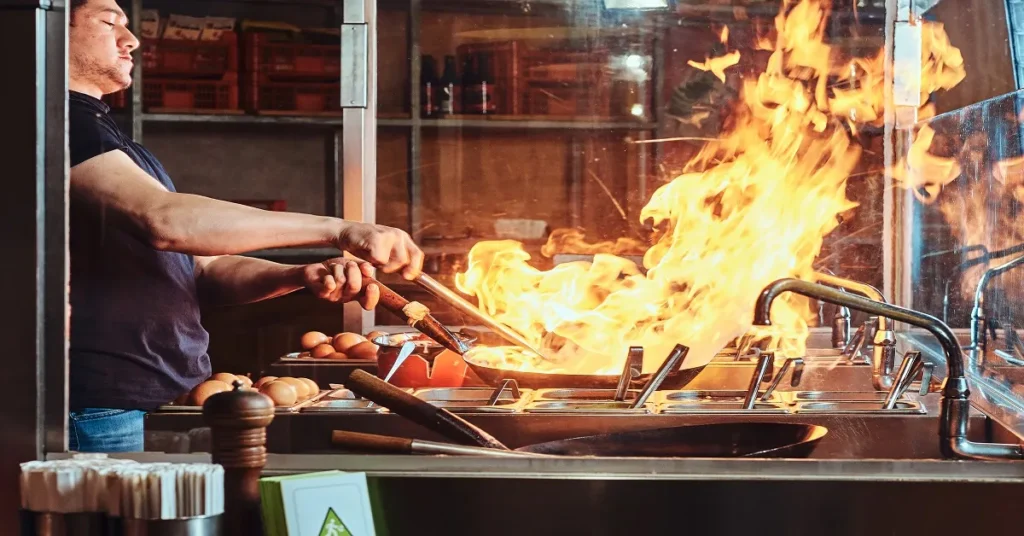

Who Is Abandoning Open Flames, and How Far Have They Gone
Across America’s — and indeed the world’s — top dining circles, the abandonment of open flames is happening in a way that surprises almost everyone. It is not being forced by policy. It is not happening overnight. Instead, it is unfolding one specific person at a time, in one specific kitchen at a time, through active choices made from lived experience.
What these people share is an undeniable weight of professional authority — heavy enough that every time one of them turns away from the gas burner, the entire industry stops to watch, and then follows.
Eric Ripert and Le Bernardin: The First Leap of Faith
In 2021, Eric Ripert made what was then a rather unconventional decision while renovating the kitchens of his New York apartment and his Hamptons beach house — he chose not to run a single gas line, and instead had Miele and Gaggenau induction cooktops installed throughout. The French-born chef who has presided over three-Michelin-star Le Bernardin for more than thirty years is not someone easily seduced by new technology. He is known for his stillness and precision.
Yet he candidly told a New York Times reporter about the specific moment that changed everything for him:
“Two days in, I fell in love with it. It is so much more precise than looking at a flame. You can really focus on the cooking itself, rather than managing the fire.” — Eric Ripert, 2022
Behind those words — “two days in, I fell in love” — lies a very clear perceptual turning point. The temperature response of an induction cooktop is nearly instantaneous. Turn the power down, and the sauce in the pan stops boiling at once. Turn it up, and the base of the pan returns to full heat within seconds. For a chef who has spent an entire career training himself to “read the flame,” being able to replace experiential intuition with precise digital instruction is not a step backward — it is a liberation.
Reports indicate that Ripert has also introduced Gaggenau induction cooktops into the working kitchen of Le Bernardin itself. It is worth clarifying that Le Bernardin’s transition is not a complete abandonment of open flame, but rather a pragmatic structural substitution with a clearly legible logic. The sauce stations and precision-control zones are now fully managed by induction equipment, because classic French sauces demand temperature stability that gas flame fluctuation directly undermines. Prep areas and holding stations rely on induction’s precise low-temperature maintenance, replacing the old approach of keeping pilot flames burning for hours. A portion of gas equipment has been retained for high-heat searing and specific French techniques that still require direct flame contact — one of the few scenarios where induction has not yet achieved full substitution.
The overall characterization of Le Bernardin is therefore not “completely flame-free,” but rather a progressively electrified layout organized by cooking function, with induction as the governing principle. This strategy — not demolishing everything at once, but letting induction first claim the territory where it excels — represents the most realistic and sustainable transformation path currently being taken by the world’s top restaurants. Ripert’s public endorsement sent a message the entire industry could not ignore: this is no longer an environmentalist’s manifesto. It is a world-class chef’s genuine statement about culinary precision.
The French Laundry, Alinea, and Gwen: The Deepening of Trust
If Ripert’s conversion was driven by personal sensory discovery, then Thomas Keller’s The French Laundry and Grant Achatz’s Alinea represent a different path — the path of institutional public commitment and earlier technology adoption. The Sierra Club’s report explicitly documents that both three-Michelin-star restaurants have publicly declared their commitment to electrified cooking.
The French Laundry introduced induction equipment into its kitchen as far back as around 2010, making it one of the earliest institutions in North American fine dining to integrate induction cooktops into the primary kitchen workflow. Alinea, as the flagship arena of molecular gastronomy, relies heavily on precise temperature control — the logical temperature management characteristics of induction align naturally with this cooking philosophy, making its transition far less resistant than that of a traditionally structured restaurant.
Curtis Stone’s Michelin one-star restaurant Gwen provides a particularly compelling “exclusive practice” case study. This Hollywood restaurant — famous for its wood-fire cooking — seems on the surface to be the last place you’d expect to find a “farewell to open flame.” The charcoal grill visible in the dining room is the very heart of Gwen’s brand narrative. Yet Stone confirmed to Robb Report that for the past several years, he has been “exclusively using induction cooktops” to execute the cooking at Gwen.
This reveals a dual-track strategy quietly spreading among the world’s best restaurants: maintain the ritual and emotional power of open flame at the front of house, while fully transitioning the working kitchen to induction electrification at the back. The following table summarizes the key details of these transformations.
| Restaurant | Location | Michelin Stars | Induction Adoption Timeline | Degree of Transition | Open Flame Retained? |
|---|---|---|---|---|---|
| The French Laundry | Napa Valley, CA | ⭐⭐⭐ | ~2010 onward | Public commitment to electrification | Partially (specific techniques) |
| Alinea | Chicago, IL | ⭐⭐⭐ | During electrification commitment | Public commitment to electrification | Minimal (molecular gastronomy orientation) |
| Gwen | Hollywood, LA | ⭐ | Completed over past several years | Exclusive use of induction in cooking areas | Retained (front-of-house display grill) |
Jeremy Chan and Ikoyi: “I Would Never Go Back” — Said After Two and a Half Years of Running Induction
Among all public statements about abandoning open flame, the most unequivocal came from Jeremy Chan, head chef of London’s two-Michelin-star restaurant Ikoyi.
“Despite my love of gas, I would never go back to it.” — Jeremy Chan, Bloomberg, 2025
The weight of these words can only be fully understood when placed back on their timeline. When Chan said this, Ikoyi’s four induction cooktops had been running stably for more than two and a half years. This corresponds to a kitchen rebuild undertaken when Ikoyi relocated to new premises around 2022 to 2023. Chan did not replicate the gas configuration of the old site — instead, he chose four induction cooktops as the operational core of the new kitchen.
This setup handles virtually every core cooking function in the restaurant: from the temperature-sensitive preparation of seafood and the delicate reduction of sauces, to the complex multi-temperature-zone cooking involved in his signature dish of lobster foam and smoked rice. Two and a half years of actual operation is not a testing period — it is a verification period. The conclusion Chan ultimately drew from it concerns not just temperature control, but the entire management logic of the kitchen.
“It reduces human error. You can be more precise in a more foolproof way. You just say ‘set it to 3.5’ — there’s no interpretation.” — Jeremy Chan
What he is describing is a fundamental shift from an “experience-dependent kitchen” to an “instruction-reproducible kitchen.” For a two-star restaurant with extremely high weekly output complexity, this reproducibility is not merely an efficiency question — it is the core guarantee of consistency, and consistency is the single hardest-to-quantify yet most consequential variable in earning and retaining Michelin stars.
Chan’s trust in induction eventually extended into his private life: he had induction installed at home as well. That step — from the professional kitchen to the domestic one — is typically the final confirmation that a chef has developed genuine conviction in a technology, not just professional pragmatism.
Why They Are Doing This — The Real Drivers
In the world of commercial decision-making, top restaurants never pay for sentiment. When an increasing number of Michelin-starred restaurants and premium dining groups begin replacing the gas burners they have used for decades with commercial induction cooktops, the driving force behind this transformation is never a fashionable shade of green. It is a cold, real invoice — and its core currency is air.
The Stanford December 2025 Study: Gas Stoves Are Turning Professional Kitchens into Chronic Exposure Sites
On December 2, 2025, a team from Stanford University’s Department of Earth System Science published the most comprehensive national indoor NO₂ exposure assessment ever conducted in the United States, in the journal PNAS Nexus. The study covered data from 133 million residential structures across the country, with field measurements spanning more than 15 cities across seven major regions. For the first time, it simultaneously integrated indoor and outdoor NO₂ data, constructing a national exposure map at zip-code-level resolution.
The conclusions of this research should not be casually glossed over by anyone who works continuously in an enclosed professional kitchen. 22 million Americans face total residential NO₂ exposure exceeding the WHO long-term exposure guideline (10 μg/m³ / 5.2 ppbv) solely from using gas stoves — even when their outdoor air quality is itself completely within safe limits. For heavy cooking users in the top 5th percentile, stove-generated NO₂ alone reaches 10.3 ppbv, accounting for more than 57% of their total indoor-plus-outdoor exposure — meaning more than half of their toxic load comes from a single lit burner.
On peak short-term exposure, more than 99% of WHO one-hour standard exceedance events (100 ppbv) are caused directly by gas stoves — outdoor pollution is almost entirely irrelevant to these acute spikes. Switching to electric cooking reduces NO₂ exposure for heavy users by more than 50%. And for all gas stove users, NO₂ lingers in indoor air for hours after cooking stops — the exposure doesn’t end when the flame goes out.
Stanford researcher Professor Rob Jackson put it with blunt precision: “If you use a gas stove, the amount of NO₂ pollution you breathe indoors is often comparable to all outdoor sources combined.”
These numbers are derived from ordinary residential settings — typically over 1,000 square feet, limited daily cooking time, occasional ventilation. A commercial kitchen operates under conditions that are more severe on every dimension: more enclosed space, 6 to 10 times more burners than a home, uninterrupted cooking throughout the day, and workers accumulating more than 8 hours of exposure daily. The Stanford data represents a conservative baseline. The real dosage in a professional back-of-house is higher, never lower.
The Two-Hour Lunch Rush: Reconstructing a Commercial Kitchen Pollution Peak
Picture a typical full-service American restaurant kitchen: a sealed operating area of roughly 35 to 50 square meters, 6 to 8 commercial gas burner units, gas ovens, and gas fryers, all running at full capacity from 11:30 AM through 1:30 PM. During those two hours, three primary pollutants — CO (carbon monoxide), NO₂ (nitrogen dioxide), and formaldehyde (HCHO) — accumulate at rates that far exceed safety thresholds.
The cooks standing in that kitchen are conducting a high-dose occupational exposure experiment on themselves — one they did not consent to, and in most cases are not even aware of.
CO risk is often the first to be felt but the easiest to mask with ventilation. Field measurements from large commercial institutional kitchens document CO peak values of 350 to 1,710 ppm during simultaneous boiling and frying operations. OSHA’s 8-hour average workplace exposure limit is 50 ppm; the short-term exposure limit (15 minutes) is 200 ppm. In a conservatively estimated 6-to-8 burner American back-of-house at lunch peak, CO concentrations routinely exceed occupational safety thresholds by multiples — this is not alarmism, it is a structural risk backed by real measurement data.
NO₂ peak values are equally striking. RMI (Rocky Mountain Institute) data shows that a single gas burner running at high heat can drive kitchen NO₂ concentrations past the WHO acute health threshold of 100 ppb during active cooking. When multiple burners operate simultaneously, peak concentrations scale non-linearly with the number of emission sources. The Stanford study confirmed that at the 95th percentile of cooking intensity, WHO exceedance days reach 7 to 15 per year — and for a commercial kitchen, that 95th percentile is simply a normal day at work.
Formaldehyde is perhaps the most underestimated hazard of all. Research from the U.S. National Institute of Standards and Technology (NIST) confirms that even low-heat simmering on a gas burner produces a significant rise in indoor formaldehyde concentrations. Formaldehyde is a Group 1 carcinogen classified by the International Agency for Research on Cancer (IARC), with established links to leukemia and nasopharyngeal cancer. For professional cooks who spend 300 or more days per year in a gas-burning kitchen, this constitutes a severely underestimated long-term cancer risk exposure that the industry has yet to seriously reckon with.
The real-world consequences of these concentration levels are becoming increasingly impossible to ignore. Research indicates that work-related illness prevalence among commercial kitchen workers is as high as 81.3%. The American restaurant industry employs approximately 12.4 million people. The combination of respiratory disease, chronic airway inflammation, and occupational exposure litigation is forming a hidden liability that restaurant operators can no longer afford to dismiss.
| Pollutant | WHO / OSHA Reference Limit | Commercial Kitchen Lunch Peak (Measured) | Estimated Exceedance | Primary Health Risks |
|---|---|---|---|---|
| CO (Carbon Monoxide) | OSHA 8h average: 50 ppm; 15-min limit: 200 ppm | Measured range: 350–1,710 ppm | 7–34× | Headache, dizziness, cognitive impairment, asphyxiation risk |
| NO₂ (Nitrogen Dioxide) | WHO 1h acute standard: 100 ppb | Multi-burner peak: can exceed 200–400 ppb | 2–4× | Aggravated asthma, COPD, lung cancer risk |
| Formaldehyde (HCHO) | OSHA 8h average: 0.75 ppm | Significantly elevated even at low simmer; higher in multi-burner environments | Significantly exceeded | Group 1 carcinogen; associated with leukemia |
Why 2026 — Two Things Happening Right Now
If you had asked any working chef ten years ago whether induction could enter a real commercial kitchen, most would have shaken their heads. “Too fragile.” “Not enough power.” “Can’t handle a cast iron pan getting slammed around.” These were not excuses — they were real engineering deficiencies that existed at the time.
But two things happened between 2024 and 2026 that fundamentally changed the terms of this conversation. They are not isolated technology headlines. They represent a historic convergence — regulation, insurance logic, and equipment manufacturing all reaching a tipping point simultaneously. Understanding these two developments is what makes 2026 the year America’s top restaurants began genuinely rethinking the power systems of their kitchens.
The First: The Technical Threshold for Industrial-Grade Induction Was Quietly Crossed Between 2024 and 2025
For years, the adoption of commercial induction in professional kitchens was blocked by a single core pain point: it could not survive the violence of a real kitchen. Professional chefs don’t gently set down cast iron pans — they slam, drag, and scrape. Running continuously for twelve hours is not an exception; it is the norm. Early commercial induction units had ceramic glass surfaces that cracked easily under this kind of use. Induction coils overheated and tripped under sustained high-load operation. Control board thermal management was wholly inadequate for the high-temperature, high-humidity conditions of a professional kitchen. This was not an image problem. It was a genuine engineering problem.
Around 2024, that threshold was genuinely crossed. The Vollrath InductIQ™ heavy-duty series brought continuous duty induction circuitry — designed specifically for uninterrupted restaurant operation — to commercial machines, fundamentally resolving the frequent tripping that had made early units unreliable in high-intensity use. High-power commercial induction wok technology matured simultaneously. Units targeting Chinese cooking and high-intensity stir-fry scenarios entered commercial viability, with some models achieving 5,000 to 8,000 watts per burner. Paired with dedicated carbon steel woks, the experiential gap between induction and traditional high-fire gas has been dramatically reduced. Some heavy-duty commercial induction wok systems now reach 30kW, matching or exceeding equivalent gas wok range output per unit time.
Impact-resistant cooktop surface materials also saw generational progress. New models widely adopt reinforced industrial-grade ceramic glass panels specifically tested and certified for the daily impact of cast iron. Purpose-built heavy-duty commercial induction systems — such as those from ATRX, a manufacturer with 18+ years of professional kitchen equipment experience — now lead with “heavy-duty continuous use” and uninterrupted operation as their core selling point, a direct engineering answer to the profession’s most persistent objection.
The UK’s Foodservice Equipment Association (FEA) documented a historic market inflection point: among the leading commercial kitchen equipment manufacturers it tracks, electric cooking equipment shipments exceeded gas cooking equipment shipments for the first time in the FEA’s decades of statistical history. European commercial kitchen equipment markets have long served as early predictors of global trends, and where manufacturer R&D capital moves today determines the product iteration priorities of the next three to five years.
Major technology enterprise customers — most notably Microsoft — also entered the picture. Microsoft reportedly partnered with equipment brand Jade to develop a 12kW commercial-grade induction wok range for its campus dining operations. Large-scale procurement from tech sector campuses drove volume production and cost reductions in product lines that are now flowing directly into restaurant supply chains.
The technology threshold having been crossed changes the fundamental premise of the conversation between restaurant owners and their chefs. The question used to be “can induction work?” The question now is “in which scenarios does induction work better?” This shift in framing is the underlying reason why the industry’s conversation has been accelerating throughout 2026.
The Second: New York and California Regulations Both Landed, Making Electrification Unavoidable in the Two Most Concentrated High-End Dining Markets in America
If technological maturity is the market’s “pull force,” then regulatory policy arriving is an undeniable “push force.” Between 2024 and 2026, New York and California each followed different paths to transform the question of commercial kitchen electrification from a voluntary option into a reality that must be addressed within a regulatory framework.
These two states happen to be the highest-density fine dining markets in the United States — and the most concentrated markets for Michelin-starred restaurants — meaning their policy directions carry systemic demonstration effects on equipment purchasing standards for national chains and hotel dining groups alike.
New York State: The All-Electric Buildings Act and Its Real Pressure
New York State’s All-Electric Buildings Act was passed as part of the 2023–2024 fiscal year budget legislation. In July 2025, the New York State Fire Prevention and Building Code Council voted to formally incorporate all-electric requirements into the New York State Building Code, originally scheduled to take effect January 1, 2026, for new commercial buildings. The core requirement: new commercial buildings must adopt fully electrified designs for heating, hot water, and kitchen equipment, with no lawful connection to natural gas pipelines for commercial cooking.
A precise account requires acknowledging that in November 2025, following a federal court lawsuit in which plaintiffs invoked federal law’s preemption of state-level gas bans — using logic consistent with the earlier case that struck down Berkeley’s similar prohibition — the New York State government agreed through a court-filed stipulation to pause enforcement of the law, pending a federal appeals court ruling. As of March 2026, the law remains in legal suspension.
However, a pause in enforcement is not a withdrawal of legislative intent. New York State’s long-term decarbonization roadmap and Governor Hochul’s consistent advocacy for building electrification mean the industry broadly anticipates this policy wall is delayed, not permanently removed. For any investor planning to open a new restaurant in New York, the opening timeline for a fine dining project typically stretches two to three years. Engineering designs and equipment procurement decisions made today lock in the compliance reality of two years hence. Full electrification has unavoidably become a scenario variable that must be incorporated into any new project’s planning.
California: Title 24 Energy Code’s Mandatory “Electrification-Ready” Requirement Takes Effect
In contrast to New York’s dramatic legislative journey, California chose a path with greater engineering certainty. California’s 2025 Energy Code (Title 24, Part 6, Section 120.6(k)) formally took effect January 1, 2026, applying to all new commercial kitchens, and established a mandatory “electrification-ready” requirement.
The regulation specifies that all new commercial kitchens — whether quick service, casual dining, or institutional — must include the following electrical infrastructure in their architectural design phase, regardless of whether they currently plan to use gas equipment:
- Dedicated branch circuit wiring and outlets in cooking areas, rated at a minimum of 50 amperes
- An electrical panel serving the cooking area with a total capacity of at least 800 amperes
- A panel configured to accommodate the addition of 208V or 240V / 50A circuit breakers for future expansion
The California Energy Commission explicitly states that these are mandatory minimums, not subject to trade-off against other energy efficiency measures within compliance modeling, with the sole exemption being healthcare facilities and kitchens that are already fully electrified. In other words, California’s regulatory logic is: even if you’re still using gas today, the building itself must be capable of switching to full electrification at any moment.
For all food and beverage projects applying for building permits in California after January 1, 2026, full electrification is no longer an optional enhancement — it is the default configuration of the building’s base infrastructure.
| Comparison Dimension | New York All-Electric Buildings Act | California Title 24 / 2025 Energy Code |
|---|---|---|
| Policy Type | Gas connection prohibition (legislative level) | Mandatory electrification-ready requirement (building code level) |
| Originally Effective | January 1, 2026 | January 1, 2026 |
| Current Enforcement Status | Federal court litigation pending; enforcement paused | Formally effective; mandatory enforcement |
| Core Requirement | New commercial buildings may not connect to gas | New kitchens must have ≥800A panel and ≥50A dedicated circuits |
| Scope | All new commercial buildings statewide | All new commercial kitchens statewide (QSR / casual / institutional) |
| Exemptions | Certain uses and scales have exemptions | Healthcare facilities and fully electrified kitchens |
| Real Impact on Restaurants | New restaurants cannot legally run gas cooking | Building structure must support instant full electrification; gas becomes a transitional option |
| Long-Term Policy Direction | Emissions targets unchanged; law expected to resume | Tied to California’s 2045 net-zero target; progressively tightening |
How Far Will This Trend Go
If one sentence could define the boundaries of the movement to replace open flame with induction, the most accurate framing might be: this is a “functional revolution,” not a “ritual revolution.” Understanding this dividing line will serve any restaurant operator better than any market report when deciding whether to follow this trend, and how deeply.
The “Flavor Blind Spots” That Induction Can Never Conquer
Induction excels at the precise transfer of heat. It can maintain a constant temperature within 0.5°C of variance — making low-temperature sous vide, fermentation temperature management, and the reduction of complex sauces nearly flawless in execution. But it carries one irreducible physical limitation: it transfers heat, not fire. And that distinction encounters a hard wall in the following cooking scenarios.
Charcoal and smoke-driven BBQ is the clearest case. Wood and charcoal in incomplete combustion release hundreds of aromatic compounds — guaiacol, eugenol, furfural — that penetrate the fibers of the ingredient to create a taste-memory that no simulated heating process can reproduce. Whether it is a slow-smoked pork shoulder from the American South, or a whole lamb roasted by Argentine master chef Francis Mallmann in the Patagonian wilderness, or the binchotan charcoal that an increasing number of Michelin restaurants are incorporating into their menus — the layers of char and smoke are fundamentally the chemical products of carbonization and volatile compound deposition. No induction cooktop, regardless of its precision, can manufacture this process at the bottom of a pan.
French flambé technique is another irreplaceable domain. The essence of flambé is direct flame contact between burning alcohol and the surface of the food — that brief, high-temperature contact not only completes the combustion of the alcohol and removes its bitterness, but forms a unique caramelized crust on the exterior of the ingredient, while delivering a visceral visual intensity to the dining room. Igniting alcohol over an induction surface is technically possible, but because the pan does not receive the flame directly, the flame morphology, safety logic, and final flavor profile differ fundamentally from the results achieved on an open-flame range — which is precisely why a large number of classic French establishments continue to maintain gas burner stations to this day.
Live fire as identity and narrative is perhaps the most commercially decisive factor. Vinnie Cimino’s restaurant Rosy in Cleveland — winner of Food & Wine’s 2025 Best New Chef award — operates a kitchen with no fryers, no stovetop, no griddle, and nothing but an open-fire grill. The menu is never announced in advance; it changes with the fire and whatever ingredients arrive that day. Before guests are seated, the first thing they encounter is the sweet smell of smoke drifting through the walls of the building — an intentional sensory prologue. For Rosy, open flame is not a cooking tool. It is the narrative anchor of the entire dining experience, and it is a brand asset that no induction equipment can replicate.
Two Types of Restaurants Are Diverging
The restaurant landscape of 2026 is undergoing a quiet but unmistakable strategic bifurcation. This is not a zero-sum game in which one side wins and the other loses — it is two fundamentally different competitive logics simultaneously strengthening, each finding its own market anchor and accelerating toward its own extreme.
The modern cuisine track, where precision temperature control is the competitive core, is embracing induction at high speed and depth. For these restaurants, induction is not a compromise — it is an upgrade. Fermentation restaurants need to maintain precise temperature curves over days or weeks. New Nordic cuisine relies on sous vide to lock proteins at the most accurate textural point. Contemporary French cuisine requires complex sauces to be managed through the Maillard reaction’s narrow temperature window during reduction. In all of these scenarios, 0.5°C of control precision translates directly into output consistency and reproducibility — and in a high-turnover fine dining environment, that is an operational asset without a price.
At the same time, another class of restaurant is moving in entirely the opposite direction — not abandoning open flame, but elevating it to the status of core narrative. Hillary Sterling’s Ci Siamo in New York, built around live-fire cooking, is already opening a second location in Boston due to its popularity. The Michelin Guide’s Global Inspectors named “charcoal, smoke, and flame” the number-one dining trend of 2026, noting that chefs are redefining the dimensions of flavor expression through wood, charcoal, heated stone, and binchotan.
This is not a nostalgic backlash. It is a deliberate differentiation strategy. In a world where induction is becoming standard, open flame itself becomes a source of scarcity — and scarcity is precisely the core premium logic of the experiential dining segment.
This divergence will ultimately split the market into two distinct quadrants: “precision kitchens” that trade technology for stability and efficiency, and “theater kitchens” that trade flame for ritual and irreplicability. These two paths are not mutually exclusive, but both are accelerating away from each other — and the muddled middle ground between them is the most genuinely dangerous place to be.
The Ultimate Anchor Point for Readers Assessing This Trend’s Boundaries
For any restaurant decision-maker, the question of whether to follow the induction trend ultimately reduces to one single question: In your kitchen, does fire serve a functional role or a ritual one?
The table below unpacks this boundary line across six actionable assessment dimensions, allowing you to locate your restaurant on one side or the other within five minutes.
| Assessment Dimension | 🔥 Fire as Ritual (Irreplaceable) | ⚡ Fire as Function (Will Be Replaced) |
|---|---|---|
| Core Menu Logic | Smoke, charcoal, and flambé are inseparable from the flavor identity of the dish | Open flame is used only for routine sautéing, boiling, and basic searing |
| Guest Perception Layer | Guests can see, smell, and feel the fire — its presence is part of the experience | Fire is in the back of house; guests are indifferent and only care about the plate |
| Menu Differentiation | Open flame is the central narrative pillar of the menu story and restaurant brand | Open flame is merely an execution tool, replaceable without affecting menu positioning |
| Technique Irreplicability | Depends on carbonization, smoke compounds, or direct flame contact — reactions induction cannot simulate | Required heat processes can be equivalently achieved through precise induction temperature control |
| Regulatory and Compliance Pressure | Holds a standalone exhaust permit and flame operation license; compliance costs are already internalized | Facing new gas prohibition regulations or continuously rising ventilation retrofit costs |
| 5-Year Strategic Direction | Using “live-fire” as a differentiation moat, deepening ritual and irreplicability | Using efficiency, consistency, and clean kitchen air as the core competitive advantage |
The “functional” dimension of fire — stable heating, rapid temperature rise, thermal transfer — will be accelerating into substitution by induction technology over the next five years. This substitution is driven not only by induction’s thermal efficiency of approximately 85% (far exceeding gas’s approximately 40%), but by the legislative reality that multiple U.S. states and cities have already moved to prohibit new gas connections in commercial kitchens.
The pressure of clean kitchen air compliance is transforming replacement from “an option” into “a requirement.” Leading commercial induction cooker manufacturers have recognized this shift and are now engineering products specifically for the demands of high-volume professional kitchens — not just efficiency, but the durability, power output, and continuous-duty performance that a real restaurant back-of-house demands.
The “ritual” dimension of fire — the smell of smoke that reaches guests before they are seated, the focused look of a chef reading the state of the coals, the irreducible unpredictability of food and flame in direct conversation — will not be replaced by any technology over the next five years or beyond. It cannot be replaced precisely because its value does not exist in any thermodynamic equation. It exists in the deepest emotional resonance between human beings and the most ancient of all cooking experiences.
Restaurants that embrace induction win efficiency, compliance, and clean air. Restaurants that double down on the narrative of open flame win scarcity, differentiation, and experiential premium. This dividing line will not disappear. It will only grow sharper as induction technology becomes further normalized — and it is the fundamental question that every restaurant must answer before it makes a single equipment decision.
Written by the ATRX Team Kristen — ATRX Commercial Induction Cooker Manufacturer with 18+ Years of Production Experience