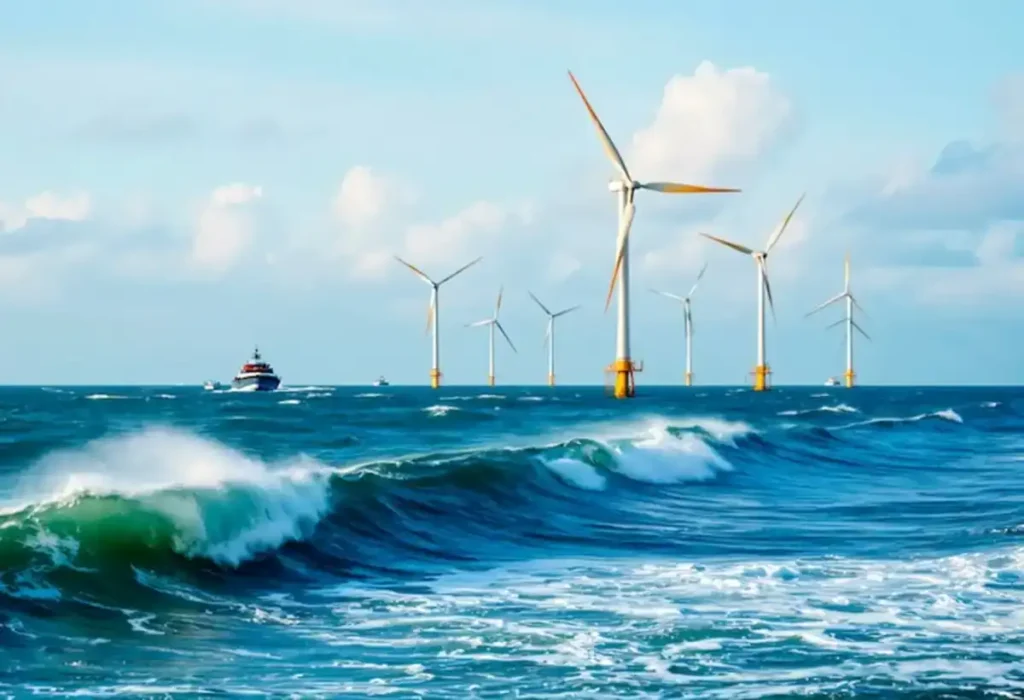

The global transition to renewable energy is moving further away from the coastline. While traditional offshore wind turbines are fixed to the seabed in relatively shallow waters, a vast amount of wind potential lies in deeper oceans where fixed-bottom structures are technically or economically unfeasible. Floating offshore wind technology is the key to unlocking these deep-sea energy resources, but it requires a fundamental shift in how foundations are anchored and installed.
The shift to floating structures
Unlike conventional monopiles, floating wind turbines are mounted on floating structures—such as spar-buoys—that are moored to the seabed. This allows wind farms to be situated in water depths exceeding 100 meters, where wind speeds are often higher and more consistent. The challenge, however, shifts from supporting the weight of the turbine to ensuring its stability against the forces of the open ocean. This stability is provided by complex mooring systems and high-capacity suction anchors.
Precision anchoring in extreme environments
To secure a floating wind farm, multiple suction anchors or piles must be installed with extreme precision on the seabed. This requires specialized equipment capable of operating at significant depths and under heavy swell conditions.
- Specialized pile driving: Using advanced hydraulic hammers, such as the S-series Hydrohammers, piles are driven into the seabed to provide the necessary tension for the mooring lines.
- Internal lifting and handling: Because these anchors are often large and heavy, internal lifting tools (ILT) are used to move and position the structures safely without damaging the integrity of the pile.
- Underwater monitoring: Precision is key; monitoring systems ensure that each anchor is placed at the correct angle and depth to maintain the balance of the floating turbine above.
Case study: The Hywind Scotland project
A landmark project in this sector is Hywind Scotland, the world’s first commercial floating wind farm. Located off the coast of Peterhead, this 30MW pilot project utilized five massive floating turbines. IQIP played a crucial role by providing the S-500 Hydrohammer and specialized lifting tools to install the suction anchors. By ensuring these anchors were placed with millimeter precision in the harsh conditions of the North Sea, the project demonstrated that floating wind is a viable and scalable solution for global energy needs.
Unlocking global energy potential
Floating wind technology represents the next frontier in offshore energy. By removing the depth constraints of fixed-bottom foundations, countries with deep coastal waters can now harness the power of offshore wind. As the technology matures and installation methods become more standardized, floating wind farms will play an essential role in a diversified and resilient global energy grid.